Working on my playstation tan
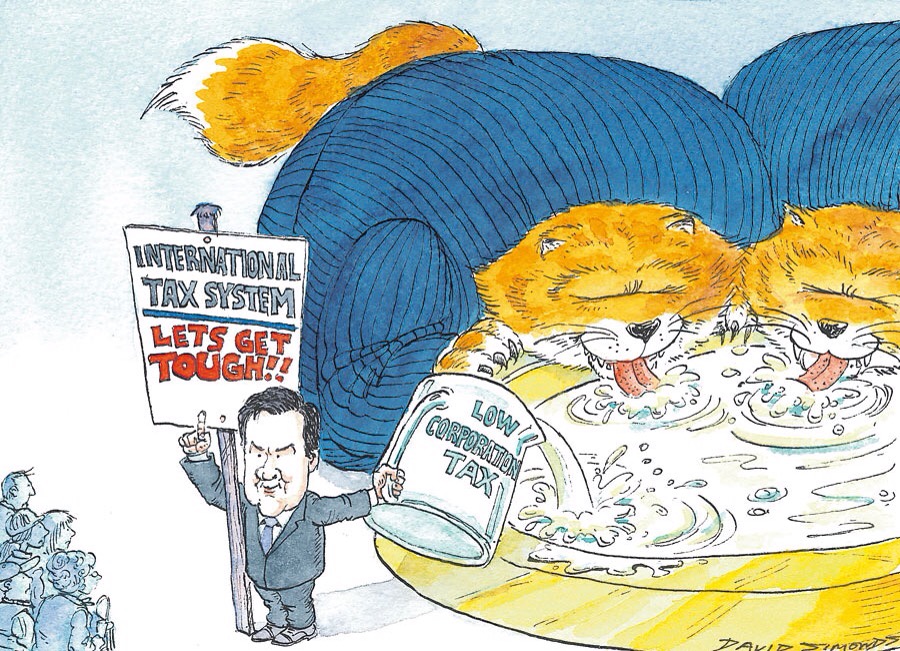
Let’s talk about tax (and multinationals).
In her time your correspondent has been mistaken for a number of things. This has included being a
- Catholic;
- Card player; and
- Lawyer
But – you know what – apologist for foreign capital really hasn’t ever been one of them. So with this in mind I have been following the campaigns against multinationals and their non-taxpaying behaviour. And much as I hate to say this – I actually feel a bit sorry for them. Not a lot mind – but a bit.
A year or so ago while I was still at Treasury I went to the Accountants tax conference. Highlights included a Hip Hop presentation from a group in South Auckland in lieu of an after dinner speech. Pretty progressive for a bunch of tax geeks.
Also one of the main presentations showed the UK enquiry on multinationals where politicians – with no sense of irony – were giving Apple and the likes biffo for how they structured their businesses in response to the laws the politicians had enacted. Facepalm.
Now the public information surrounding multinationals non-taxpaying isn’t pretty. Double Dutch Irish sandwiches and the like. Great for headlines but not for taxbases.
All done through a combination of being in a country in substance but not for tax – the preparatory and auxillary out from a permanent establishment; treaty shopping in the form of royalties going to low tax counties and/ or excessive royalty payments. None of it – even to me – is the behaviour of a good corporate citizen.
But here’s the thing – in New Zealand a country where tax laws can be changed and cases can be run successfully in the courts – one of two things will be the case:
Option one. It is tax avoidance.
Now when I say ‘tax avoidance ‘ – this is tax avoidance in terms of the statutory provisions not tax avoidance coz people think they should pay more tax than they are.
If it is tax avoidance according to the law then my former colleagues will be getting right stuck in. Now Corporate Legal – remember breathe out – all these issues are beyond public domain. They would – Corporate Legal note conditional tense -be getting right stuck in as they/we did with the banking cases; avoidance of the top marginal rate; and the hybrid instrument cases. None of which required public outcry before that happened. Just a tax department getting on with its job.
However public outcry is pretty awesome for the front line in tax policing. Always good to know you are on same page as people you are serving.
Now there is quite a delay from problem indentification to going to court – dispute rules; fully discussing the issue with the taxpayer; briefing experts and ensuring all parts of the department are on board or at least don’t disagree and so on. And then there is the possiblity a taxpayer settles; in which case it is never public.
But dear readers never assume that just because you haven’t heard anything that nothing is happening. Because secrecy provisons. The very same ones I spend every blog post negotiating.
Option two. It is not tax avoidance in terms of the statutory provisions.
Now if that is the case this means the outcome was intended by Parliament. In the same way currently:
- Sales of businesses; houses; farms and other assets such as shares bought without the intention of resale are not taxed;
- Interest deductions for capital assets that may have incidental income are allowed and can be offset against other unrelated income;
- Income earned by contractors who do very similar work to employees are allowed work related deductions;
- Imputed rents are untaxed;
- Industries such as bloodstock and forestry either have accelerated deductions or deductions for capital;
- Businesses operated by charities are untaxed;
- There can be significant delay between income earned at the company level and when it is paid out to shareholders
- Transfer pricing or associated persons rules don’t apply to consortiums acting together as one entity;
- The thin capitalisation rules allow businesses funded by creditors the ability to strip profits by way of excessive interest.
Now there is also a move to make multinationals disclose how much tax they pay. Ok cool. But why is it only multinationals and not any beneficiary – which would include a lot of you dear readers I know it would include me – of the above list? Why is their non taxpaying so special?
And here’s the thing. Parliament – or really the government of the day – can change its mind. So if any or all of the above is ok but the multinational thing isn’t – Hon Mike can propose a law change. The current solution du jour is a diverted profits tax.
So maybe the target of the campaigns should be the politicans who continue to allow it rather than some companies that couldn’t help themselves? Just saying.
The campaigns will have been very useful in giving Hon Mike an ’empowering environment’. But maybe coz Hon Mike hasn’t done anything yet maybe it is tax avoidance. Even then taking avoidance cases ad infinitem is no way to run tax system.
So Hon Mike GET ON WITH IT!
Coz it is not like boycotting products is an option. At least for me. I am an Apple addict. Not so sure about ios 10 though.
One final thing dear readers – although I am now back to posting twice a week – Monday is Labour Day. So as a good lefty I am downing tools and will be back next Friday.
Namaste.
Everything is connected to everything else
Let’s talk about tax.
Or more particularly let’s talk about about a case I mentioned last week in the alignment post. It was quite controversial at the time within the tax community and did leak out a bit into the general public. As is often the ‘case’ tax is just an overlay on other interesting stuff.
Also thought of it again wot with the junior doctors strike and how the consultants would be helping over that period. I guess coz its Health that means its not strike breaking?
Anyway back to the case. Penny and Hooper (last names) were both specialist doctors earning shed loads of cash in Christchurch fixing the bung knees of those who were in denial about the length of their running careers and had yet to find yoga.
Now these gentlemen were unremarkable in that they weren’t big on paying tax according to the progressive tax scales that applied to little people and so adopted a structure recommended by their accountant. I mean everyone was doing it and what could possibly go wrong. In fact even John Shewan – of Shewan report fame – said it was bog standard behaviour.
The wheeze was that they put their businesses into a trust which at that time had a lower tax rate (33%) than the little people faced who earned over $60,000 ( threshold increased at some point but detail not relevant) 39%.
The Commissioner who was a he at the time – yes Virginia men can be senior public servants – was not best pleased. He used a bunch of words like ‘tax avoidance’,’market salary’ and ‘not’and made them pay tax like the little people. Go Team Commissioner.
The tax community also used a bunch of words like ’emmently foreseeable’; ‘lack of certainty’; and ‘chilling effect on investment’. Well maybe not the last set but that is never far away when the big people are being made to pay tax.
Anyway the Commissioner won; tax accountants lost; largely graciously ate that and everyone moved on to the next tax dept v tax community stousch.
There was some commentary at the time about how this was more than a tax case – at which point I got very excited – only to find it was about trusts could be looked through and weren’t as inviolable as people thought.
But what was never discussed was how two men who were educated at the state’s expense presumably before student loans; weren’t bonded; and whose business was almost wholly paid for by the taxpayer via ACC were earning so much money. I guess it was before the days of ‘joined up government’.
I also guess Labour’s ‘three years free’ policy will also remove what little royalty we currently get from the taxpayers’ investment in such lovely people.
All the more reason then guys to make sure misalignment works and they do actually pay the top tax rate.
Namaste

Trumping the tax system
Let’s (briefly) talk about tax (and Donald Trump).
Your (foreign) correspondent is very comfortably ensconced in the spare bedroom of her darling friend in Geneva. Reviewing my Facebook newsfeed – as well as giving me the most recent memory of my son and his girlfriend looking totally adorable going to a ball last year – was someone sharing this:
It discusses that Donald Trump claimed a $915 million loss in 1995 that could then be offset against any taxable income for the next 15 years.
Now the thing dear readers is – as I discussed in ‘The apple doesn’t fall far from the tree’ that is technically totes possible in New Zealand too. Putting capital into a business – spending it on business expenses – and then losing it will give you future losses to offset against other taxable income. But unlike in the US if you sell the business – rather than the company – for a capital gain the company keeps the losses and gets a capital gain that can be distributed tax free on liquidation.
And if it is done through a Look through Company the losses and the capital gains can pass through to the individual shareholders.
Now all of this could be totes fabulous as a means of encouraging entrepeneurship and innovation or simply entrencing dynastic behaviours. Couldn’t tell you.
Maybe Grant something for your ‘Fairness’ working group?
Namaste
Who is the fairest of us all?
Let’s talk about tax (and fairness).

Fairness (or equity) and her sister Efficiency are two of the touchstones for tax policy. There is also a younger sister Simplicity but she tends to get left at home the second anything gets contentious or revenue is at risk. For Jane Austen readers think Margaret in any Sense and Sensibility adaptations.
For years Fairness was only paid lip service to and Efficiency was the queen. But now with news of multinational non-tax paying and the fallout from the GFC, Fairness is getting profile. At this point having got in a Margaret reference I was wanting to make a Kate and Pippa reference or even a Kim and Khloe one. But neither of them really work as an analogy so I won’t.
Now as pleased as my inner left leaning tax geek is about Fairness/Pippa/Khloe getting the attention now, unlike Efficiency, Fairness means different things to different people.
I am sure dear readers that a number of you have either raised children or are still in the trenches. I am sure also dear readers that while you always try to be fair; quickly you find fair is a relative concept.
You spend more time with the child who finds reading difficult. Now that is fair to you because that child has difficulties your other children don’t have. Strangely the other children may not see it that way.
They may not see the learning difficulty. Even if they do their view may be that is just how the cookie has crumbled and as your child they have an equal right to your time. Anything other than equality is simply unprincipled favouritism.
With tax the equivalent arguments run like this:
To the left what is fair is those who have the most should pay the most. And the more you have the more you should proportionately pay. This is also known as vertical equity and is the basis of the personal progressive tax scale; lower incomes pay a lower proportion of their income in tax than higher incomes.
To the right what is fair is that everyone pays the same or at least everyone pays the same proportion of their income.
The former which was taught to me in ECON 101 – in the same year I voted for the NZ Party – is a flat or poll tax. It is the economically most efficient tax as it doesn’t distort decision making at all kinda like a negative universal basic income. It is also arguably very fair as every person pays exactly the same amount of tax. And what could be fairer than that?
It is however HIGHLY regressive meaning it hits the poor far worse than the rich as potentially it could take all their income. But it is the same as the child without the learning issues wanting the same amount of time from a parent as the one with the learning difficulties.
Your correspondent has memories of her farewell party in 1990 before going to London. Actually lots of memories as her darling friend R was making her drinks. But on the telly there were riots in Trafalgar Square as Margaret Thatcher was bringing in a poll tax. And that was only to replace rates.
So perhaps for this reason or just genuine human decency I have never heard the right in New Zealand proposing taxation being the same amount per person. But if fairness is the touchstone a poll tax could be considered fair as well as highly efficient.
Normally the right advocates flat (or flatter) tax rates. They tend to invoke the other sister Efficiency when doing so but there are also fairness arguments to support their position.
The main one is that it is fair that everyone contributes the same proportion of their income to society. And the left doesn’t need to stress as those who earn more will by definition always pay more in absolute terms.
Right. So what is a future lefty government to do that wants more fairness of the tax system. [I know you’ll want to reach for raising the top tax rate because – sigh – that increases vertical equity. But tax rate alignment does matter and if you want to do this you’ll need to do a bunch of other tail chasing stuff too. A future post I feel. And yes I will talk about multi-nationals at some point.]
As a good former bureaucrat I am all about the solutions. The key to improving the tax system is a combination of an examination of the application of horizontal equity – is income of different sources taxed the same way – combined with some old fashioned integrity measures aka closing some loopholes. Most of which will involve refinements of income classification, deductions and timing. But there is no silver bullet.
Should give you an opportunity to also throw around Andrew Little’s quote about the average Auckland house earning more than the average Auckland worker. I do enjoy that one. Whether you get re-elected is beyond my ken as every hole in the base has a highly motivated constituency for whom equality feels like oppression. Imputed rents anyone?
Will also need to watch out that you don’t give away the farm. Coz a tax base is built on asymmetries and nothing feels less fair than being on the wrong side of an asymmetry.
But if this talk of fairness is code for raising substantially more revenue then in that case you need higher rates across the board not just on high income earners; a different base or to stop adjusting thresholds for inflation. Treasury has already done that work in the 2013 Long Term Fiscal Forecast which is worth a read. None of that should be too hard to package as fair as even a riot inducing poll tax can be packaged as fair.
I am on a yoga course this week so it seemed appropriate that the Friday post be on tax and yoga. But I will return to this topic when I have the energy. I will also think about who Labour should put on their working group.
Namaste.
 Let's Talk About Tax NZ
