‘But I’m a director of a land-owning company!’
Let’s talk about tax.
Or more particularly let’s talk about tax; interest deductions and private expenditure in companies.
Your correspondent has returned from her ‘retirement cruise’; is recovering from jetlag and has returned to what passes for work these days. That will dear readers include a return to twice weekly posting. As a change from some of the more political posts I thought I’d return to a technical issue for a bit of light relief.
Earlier this year while I was still inside I went to a dinner party in a provincial city. At the party was a delightful gentleman I had met previously and was more than pleased to see again. The feeling appeared to be mutual and our conversation broadly went like this:
DG – Now Andrea tell me – which is better? To pay my mortgage or to pay my tax?
Me – cough, splutter, mumble – well the thing is it isn’t a choice as tax is a legal obligation.
DG- oh don’t be silly of course I know that. What I mean is it better to have a mortgage on my house get the tax deductions and then have money to invest in shares and things for capital gains or have no mortgage not get the tax deductions but have more disposable income?
Me – Ah what makes you think you get a tax deduction for the mortgage on your house?
DG- This is the country – we get tax deductions for all sorts of things and besides I’m the director of a land owning company!
Me – Is that wine over there?

Now dear readers I am sure after Zen and the art of tax compliance you all know that to get tax deductions the expenditure has to be:
- Connected to the earning of income or in the ordinary course of a business and
- not private or domestic expenditure.
So therefore if DG owns his house in his own name – or in a family trust – as neither 1) or 2) is met there is no deduction for interest expenditure.
There is the possibility that if the money were borrowed on his house and used to buy shares THAT WERE DIVIDEND PAYING then the interest would be deductible. But if the money is borrowed to construct the house for him to live in – nuh.
The complication though is the comment about being a director of a land owning company. The rules above do not apply to a company and interest deductions. From about 2000 or so the rule broadly became:
- Are you a company resident in New Zealand?
- Have you incurred an interest expense?
If yes to both, then ‘would you like interest deductions with that?’
The private and domestic test still applies to such expenditure but I have always struggled to align any concept of private and domestic to a company.
So at first pass – yep – if DG holds his house in a company – in your correspondent’s view – he will get an interest deduction.
And yeah the Mixed Use Asset rules won’t apply here because ironically it isn’t a mixed use asset – it is wholly private and domestic.
But – not so fast – the music hasn’t stopped.
While there are special rules for companies and interest deductions there are also special (dividend) rules for transactions involving companies and shareholders aka ‘are policy makers really that dumb?’
These dividend rules say where ever there has been a transfer of value from a company to a shareholder there is a taxable dividend to the shareholder to the extent of the value transfer.
Ok again in English.
If a company gives a shareholder stuff – goods or services – that is a taxable dividend for the shareholder. Here the company has given the shareholder use of a house – so the shareholder DG – gets a taxable dividend.
And by ‘taxable dividend’ yes this means you need to put that value on your tax return and pay tax on it. And yes I know you didn’t get any actual cash but that doesn’t matter. You know how when you tick the box for dividend reinvestment on your publicly listed shares – you know how the dividend is still taxable even though you didn’t get any actual cash. Consider this as the same.
So what is the value that DG has received from the ‘land owning’ company? He has received the benefit of living in that house. And what do people usually pay for the benefit of living in a house they don’t own? You’re onto it – rent.
DG is then up for tax on the value of the rent not paid to the company as a dividend. And once more with feeling – it doesn’t matter that no cash has been paid from the company to the shareholder.
So the benefit DG received – use of the house without paying rent – is taxable to DG.
Now if DG has a tax rate of 33% – as the company tax rate is 28% – there will be a net 5% tax paid on the ‘imputed’ or deemed rent. That is he pays tax at 33% on the deemed rent and the company gets a deduction at 28% on the interest expense. In other words a gift to the people of New Zealand and how tax planning can go wrong. And if he didn’t know this was the case until my former colleagues come along – it will be 33% tax plus interest at about 8% plus a penalty of between 10% and 100%.
Awesome. Can only hope he didn’t also pay an agent for this wizard advice.
If his tax rate though is lower than the company rate this is where it could get really interesting. Technically even with DG putting the value of rent on his tax return there will still be a net tax deduction that ostensibly can be offset against other income.
In this case though the structure – or ‘arrangement’ as my former colleagues may start to call it – is really putting pressure on the whole ‘companies can’t have private expenditure’ thing. And from here we move into a complete world of pain – or ‘good case’ depending on which side you are on this – known as tax avoidance. Now the entire interest deduction is at risk with tax avoidance penalties of between 50% and 100%. Fun huh.
And don’t even think of paying rent to your company and making it a look through company so you get the deductions directly against your other income. The department was very clear with look through companies – the prequel – that this was tax avoidance too.
So DG I am not sure there really is any ‘country immunity’ for interest on your personal mortgage. Pay it but step away from the tax system. There be dragons.
Namaste
‘You’re not one of those people are you?’
Let’s talk about tax (and tax rate alignment).
Your (foreign) correspondent is finishing up her ‘retirement cruise’ and gearing up to make that execrable journey home – also known as long distance economy class travel.
The yoga is going well too – thanks for asking – even without regular access to a studio. In large part to now knowing how alignment needs to work with my skeleton rather than that of a textbook Indian man.

So I have been thinking about this, how foreign tax systems are pretty much all misaligned, and that I promised to talk about the tail chasing stuff needed to make a higher top marginal tax rate work – or at least not not work. Because like misaligned bodies in yoga; misaligned tax systems also need props to work.
So today dear readers you get top personal tax rate alignment issues.
A couple of years ago while I was still a Treasury official I was at a social engagement and found myself talking to a Greens’ supporter. We were talking about the Christchurch earthquake and the rebuild and stuff – yes I do have all the fun – and the convo went something like this:
GS: You may remember that Russel proposed an earthquake levy as a means for the whole of the country to support Christchurch.
Me: yeah I remember that and on the face of it it did have merit – the problem is that whenever you increase the gap between the personal rates and the trust and company rate – you get people moving income into different forms. You may not collect all you think you will.
GS: [eye roll] you’re not one of those people are you? Other countries cope.
Well yeah I am ‘one of those people’. I really do like alignment and again not from a ‘purity of the tax system’ thing but because – like keeping R&D tax incentives out of the tax system – it serves us. It serves us because no matter how clever people want to get with their structuring – you always get the same result.
HOWEVER
Alignment – like a capital gains tax is not a silver bullet and – doesn’t mean:
- everyone magically starts earning income in their own names or
- income that isn’t taxed magically starts becoming taxed
It just means that there is no incentive to start finding a bunch of non-tax commercial reasons that coincidently mean current taxable income is now earned in different lower taxed forms.
But next lefty government if you do want to raise the top rate for individuals – you are going to need some tax props to stop or reduce the tax injuries. That is how othe countries cope. Have a look at page 36 of IRD’s 2005 BIM.
First thing that is beyond key is the trust or trustee tax rate. This must be raised too as income taxed at the trustee rate can be then given to beneficiaries without any more tax to pay. Australia has. All the Penny and Hooper drama happened because the trustee rate wasn’t raised too.
However there are potentially some collateral damage issues from this – aka political risk:
- Will estates
- Trusts for the ‘handicapped child’ or the disabled relative
Australia deals with these respectively by taxing at the progressive tax scale and giving the Commissioner a discretion to alter the rate. In the last – and possibly both – cases face palm. Given our tax administration’s aging computer and business transformation programme – a better option would be treating them like widely held superannuation funds and giving them the company tax rate.
You could also do something like giving them a non-refundable tax credit to get the rate back down to 33%. That technology was used in cashing out R&D losses. But this is all second order design detail and nothing officials and/or your working group can’t sort out. No biggie. It might be a bit messy but nothing compared to the carnage involved with not aligning the trust rate.
Next issue is companies and that is a bit harder. I am assuming raising the company tax rate is off the agenda – yeah thought so.
Misalignment with the company rate – as we do now – is marginally less risky as distributions from companies – dividends – are taxed in the hands of the shareholders. And they use my personal favourite technology – the withholding tax. There is currently an additional withholding tax on dividends when they are paid bringing total tax up to 33%.
You could keep the additional withholding tax at 5% and make people file who need to pay more tax – as there was no withholding at all last time there was a 33% company rate and a 39% top rate. But there also wasn’t alignment with trusts and that went well.
Or you could raise the withholding tax to – say – 11c and people who need refunds would then need to file. Or possibly a progressive withholding system from say 5c to 11c. All technically possible. But all options will raise compliance costs on taxpayers and/or administration costs on IRD. And remember the aging computer thing?
The real issue is whether our dividend rules last properly looked at almost 25 years ago can stand the strain of say a 11c difference between the company rate and top personal rate. There are ultimately limits to how long people can pay themselves $70k salaries but have a $200k lifestyle. You need to make sure you get that extra 11c when they decide to sort out that gap.
Alternatively you may like to consider making the look through company rules compulsory for all closely held companies. This would mean the company wasn’t taxed and all the income went to shareholders personally.
Neither issue will need to be part of the first 100 days tax changing under urgency that is de rigeur for new governments. It can be sorted out with consulation and will be better for it. But you will need to be prepared to use these tax props if you don’t want the 2000 – 2009 mess again.
Think that’s it.
Hardest thing will be reprioritising the existing BT and BEPS work programme to get space for this and your new fairness working group stuff.
Namaste
Trumping the tax system
Let’s (briefly) talk about tax (and Donald Trump).
Your (foreign) correspondent is very comfortably ensconced in the spare bedroom of her darling friend in Geneva. Reviewing my Facebook newsfeed – as well as giving me the most recent memory of my son and his girlfriend looking totally adorable going to a ball last year – was someone sharing this:
It discusses that Donald Trump claimed a $915 million loss in 1995 that could then be offset against any taxable income for the next 15 years.
Now the thing dear readers is – as I discussed in ‘The apple doesn’t fall far from the tree’ that is technically totes possible in New Zealand too. Putting capital into a business – spending it on business expenses – and then losing it will give you future losses to offset against other taxable income. But unlike in the US if you sell the business – rather than the company – for a capital gain the company keeps the losses and gets a capital gain that can be distributed tax free on liquidation.
And if it is done through a Look through Company the losses and the capital gains can pass through to the individual shareholders.
Now all of this could be totes fabulous as a means of encouraging entrepeneurship and innovation or simply entrencing dynastic behaviours. Couldn’t tell you.
Maybe Grant something for your ‘Fairness’ working group?
Namaste
Switzerland of the South Pacific
Let’s talk about tax (and foreign trusts).
Your (foreign) correspondent is having a lovely holiday – thanks for asking – and is about to get on a train to visit a friend in Geneva.

Several lifetimes ago – my children and hers – and long before I discovered tax or yoga, as young women we worked for a US oil company in London as management accountants. As well as being pleased to see her I am always interested to see how she is doing in a parallel lives kind of way. She stayed and career tracked and I – well – didn’t. In a substantive sense though our lives are very similar other than maybe her husband had to give up work and my french is better.
Before the Panama Papers our prime minister – bless him – gave an interview where he had a vision for New Zealand as the Switzerland of the South Pacific. Interesting desire as it is a country where women only got the vote in 1971 and one in which a senior employee of a major US company cannot afford to live comfortably. It is french speaking though so maybe it could grow on me as an idea. But then maybe he was just thinking rich with awesome mountains and great chocolate rather than exclusive and secretive. Somehow I doubt it.
And pre Panama Papers foreign trusts fitted a little too well into that vision. Professional advisors charging fees to help rich foreigners hide their money from others. Or maybe not.
In ‘Thank you for Smoking‘ a favourite line of mine is that:
[cigarettes] are cool, available and addictive. The job’s almost done for us!.
And with foreign trusts there was no tax, little disclosure and no requirement for the money to actually ever come to New Zealand – the job was almost done for them! But after 25 years our valiant foreign trust industry with extensive marketing had only managed to earn $24 million a year with $3 million in tax.
In all the arguments about whether New Zealand was a tax haven or not, one argument got missed by the opposing side. Tax havens charge fees or levies or require the dosh to be parked in the country concerned. None of which applied here. So as a country we got the bad name but not the income – genius.
Now we have the Shewan report and John had recommended increased disclosure as had other commentators and the Greens. And I agree this should staunch any reputational damage. The difficulty I have with this though as this simply replaces one cost – our reputational damage – with another cost – additional Inland Revenue administration and distraction from their real job of ensuring compliance with our tax system.
All for $3 million in tax which may well reduce once increased disclosure is in place. At least Hon Mike please reconsider Mr S’s rec for registration fees. $50 upfront and $270 per year – really? I had no idea the department could do its job so cheaply.
Personally I prefer taxation as these are ultimately entity hybrids creating double non-taxation in the same way as the limited partnership or the unlimited liability company – both of which are registered. And it appears from paragraph 7.29 Hons Bill and Mike are open to it. Whether it survives consultation is another thing entirely.
Coz Hon Mike you are right to be considering it and I’m right behind you. If we really aren’t a tax haven then isn’t it fair that the NZ foreign trust is treated the same way as all other entity hybrids? Isn’t consistency a hall mark of a good tax system? And aren’t the foreign trusts in New Zealand for a bunch of legitimate reasons that have nothing to do with tax?
So – On y va!
Namaste
The Kiwi Temp
Let’s talk about tax, (withholding and labour hire firms).
Your (foreign) correspondent is in London this week catching up with friends and family over a quarter of a century since she arrived for her big OE. My timing was exquisite as the month I arrived – April 1990 – almost perfectly corresponded with the start of the Exchange Rate Mechanism recession and my departure in December 1993 with its ending.
Having lived through that I never want to live in a country again that does not have control of its monetary policy. For all Michael Reddell has concerns over Graeme Wheeler’s stewardship; what New Zealand is facing currently is nothing compared to what England in the early 90’s faced. That is being in recession with high interest rates all because Germany had inflationary pressures due to reunification.
The experience was all the more wonderful as my working career in New Zealand in the late 80’s as a junior accountant had involved losing my job twice without redundancy. Unlike a number of my peers though I was never unemployed. Had some less than wonderful employment experiences but never unemployed.
In April 1990 I had no idea though of the forthcoming recession and did what every other young antip professional did when arriving in London – I became a temp.

I worked for Warner Music using Lotus 123 to put together the monthly management accounts. This largely consisted on taking the general ledger and repackaging it into a usable form. It sounds easy but it wasn’t. My colleague whose desk was in front of mine did the same thing for the balance sheet. After several days and lots of checking with each other we would get the same number and we would stand up and high five each other. Yes we were cool. And our manager would then breathe a sigh of relief that he would be able to deliver that month.
I imagine Xero now does what Serjit and I did then.
Warner Music was based in North London – Alperton – and was a huge eyeopener for the white girl from Christchurch. Highlights included:
- My (Jewish) manager eating his bacon sandwich complaining like mad about the bombing of Jerusalem by Iraq because – it had interfered with the football game he was watching.
- Asking my very happily married (Sikh) colleague how he met his wife and being told it was arranged.
- That lots of the happily married young people in the warehouse and the office had arranged marriages.
- Being asked if New Zealand celebrated Christmas.
- Wearing jeans to work – it was a record company.
- Discovering that the white South African auditor was not only a perfectly reasonable human being – but that I had more in common with him than I did the English. FWIW the two of us discussing issues used to have the office in hysterics with our accents.
Anyway back to New Zealand tax. As a temp I worked for a labour hire company and not for Warner Music. The received wisdom was there were two ways I could be employed. Through my own personal services company which is what the cool kids did. They all had accountants and could claim expenses. Or through having PAYE deducted.
I cannot for the life of me remember why – but I went into the PAYE system. And oh man that was the right thing to do. I saved myself a world of pain because ultimately I saw the cool kids having to make appointments with accountants during chargeable work time; organise all their bank statements; and find cash for large tax payments. Although I didn’t see it I would imagine there was also a degree of just letting it all go and getting on a plane – effectively with their tax money -when their visa ended.
But all this ‘I am an independent contractor employed through a company’ stuff was a complete nonsense as they were employed by their labour hire firm as much as I was by mine.
Now Hon Mike is having a go at this nonsense in New Zealand. Nice one Hon Mike nice one. In the recent bill he is making labour hire firms withhold from all payments to all people and ‘companies’ they place. A good start. There is still all the people who contract outside those firms and whose activities are not on those schedules. You know – policy analysts for example. Next bill will be fine.
Recently the Labour party also had a go in this area trying to get the minimum wage legislation extended to contactors. The select committee report discusses the issues quite well including the general issue of the move from employees to contactors in the labour market which is of course a move out of withholding with the consequent risks to the PAYE tax base.
I was also pleased to see this discussion as in Budget 2012 the government replaced the child’s tax credit with a tax exemption for non PAYE income for children at school. David Cunliffe – I think – called it the Paper boy Tax budget. Nice line. But from the opposition there was a lot of wailing that these children would earn $20 for 5 hours work and now they would only get $17 because of tax. At the time I remember thinking:
- gosh that is a low hourly wage
- seriously – it is the tax that concerns you in that scenario?
But to be fair it was removed under budget night urgency where the opposition gets zero prep time. So with more prep we got the entirely sane and well thought out bill from David Parker. Tax however was missing.
It is entirely likely that such low income workers are using every dollar they earn and not meeting their tax obligations. Now Hon Mike you and I both know that this is called tax evasion. And you and I know this is a criminal offence; carrying a risk of a 150% penalty and jail time.
So Hon Mike how about a bit of joined up government. You already control the Revenue and Labour officials. Treasury whether it is Tax, Labour Markets and Welfare or Social Inclusion must also have a view.
And your government has made such an artform of swiping the best ideas from the opposition.
So go on. Nick this one too. Slap withholding obligations on the payer and call it your own.
Namaste
Moral and fiscal failure
Let’s (not) talk about tax.
Let’s talk about our criminal justice system or more particularly our prison system. There are now – or will be soon – institutional reasons I can’t do this so I thought I’d give our current and future Ministers of Finance a virtual guest slot. I am shattered from that uniquely antip experience – economy class travel to the Mother country – so Ill leave it to them today. Tax treat at the end to keep you reading.
Current MoF – May 2011
Hon Bill from 2 min 50 til about 6 mins – the moral and fiscal failure speech. Focus on the content and not the delivery.
Future MoF – April 2012

(Future Hon) Grant speech to the Howard League. No youtube video I am afraid but you can hear the delivery even when reading it. Significant overlap with Hon Bill.
Extra for those who kept reading!
Now tax peeps if you have got this far here is the treat. Grant Robertson on the bill that repealed cheque duty under urgency. I can only dream of such material with Budget 2017. First 4 mins are cheque duty but rest pretty good too.
One final thing dear readers. While I am on my retirement cruise I am invoking the ‘except when there’s not’ condition in my Monday and Friday posting clause. Until late October I will only be posting on Fridays – except when I don’t.
Namaste
‘I choose you – Pikachu!’
Let’s tax about tax (and hybrids).
Early in my first stint in the field I properly discovered hybrids. I was just so impressed. Impressed in a German high command discovering Enigma had been cracked kinda way – but impressed none the less. Here were instruments/entities/transfers that could render up tax benefits without tax authorities getting exercised and using words like avoidance, unacceptable or frustration. In the midst of the Structured Finance investigations to look at something so clean and so simple but so (tax) deadly was awe inspiring.
Some people may remember where they were when JFK was shot. I remember when I fully analysed my first Australian Limited Partnership – sitting at my desk at work – ticking off all the legs; finding it fully complied with Australia AND New Zealand’s law but it generated a net deduction. Like I say – completely blown away. As time went on I started to see a place for those words avoidance, unacceptable and frustration- but first love is a very special thing. Ash Ketchem may have got subsequent pokemon but Pikachu was always his first love; and the Australian Limited Partnership was my Pikachu.

And then like pokemon once you see/catch one – you start seeing them everywhere. There were your every day hybrids hiding in plain sight like the workhorse the redeemable preference share. Like Bulbasaur, solid and dependable. Deductible in Australia and imputable in New Zealand – until they weren’t. Then came blasts from the past the convertible note sisters – mandatory and optional – Squirtle and Charmander respectively. Deductible in New Zealand and not taxable in Australia. Or even the well old vehicle the New Zealand unit trust, like Snorlax always there. Loss consolidatable in Australia and New Zealand – until it wasn’t.
Charizard, or repos, played a major part in the Structured Finance transactions. Full bodied and lethal. Here legal ownership was recognised in New Zealand but not in the United States. Whoa. Definitely an evolved form.
There were also lesser known ones. The New Zealand unlimited company – like a company but with no ltd at the end. Kind of an Ekans with no tail. Company treatment in New Zealand and partnership in United States. Losses counted twice – Awesome.
And not to be out done New Zealand also created its own. The New Zealand Limited Partnership; like an Australian Limited Partnership but newer. So Raichu in other words.
There were also exotic ones. My particular favourite was the mandatory preferred partnership interest aka the redeemable preference share for limited partnerships. Like Togepie (or Jigglypuff) just so cute.
So many pokemon hybrids so little time!
But now Hons Bill and Mike have decided they should all get back in their balls; pokemongo should be deactivated; and the gameboys should be retired. Good call boys good call. Because like pokemon they were glorious but now it is time for us all to do some real work.
Namaste
Bright and shiny and new
Let’s talk about tax.
Or more particularly let’s talk about incentives for research and development.
Your correspondent has just arrived in Sydney for the start of what her husband delightfully refers to as her ‘retirement cruise’. That would be broadly accurate except for the fact that I am not fricken retiring – I’m on a gap year ok! and there will be no boats involved. Planes – yes – and lots of trains – yay I love trains – but nothing actually ocean going.
But with an aunt, uncle, cousin and now son and his girlfriend in Sydney I have now more family there than I do in parts of New Zealand. So it is only logical that I should come here more often than in the past and the fact that the weather is better plays no part in it. Given it is Sydney I should also reference shopping but I hate shopping – other than online shopping, probs a future GST post I think – so I won’t.
Being in Australia figured I should do a compare and contrast tax post. What to choose? What to choose? Tax free threshold?; extremely high top marginal rate?; stamp duties?; payroll taxes?; offshore banking unit?; GST exemptions?; carbon tax?; substance based approach to instrument classification? All important issues and ones I will only really ever be able to properly discuss if I am actually in Australia – so happy to take that for the team.
But today dear readers you get research and development tax credits which lots of countries – including Australia – have.
Now other than during a brief period at the end of the last Labour government, New Zealand does not give explicit tax incentives for research and development. R&D expenditure does however get more concessional treatment than other business expenditure:
- it is deductible until it is capitalised for accounting
- Consequential losses are not lost on a change in shareholding and
- Losses can be cashed out up to a limit.
Plus as discussed on Monday gains from successful entrepreneurship in the form of serial business owning are unlikely to be taxed and there is no clawback of any residual losses if the business rather than the company is sold.
And none of this is included in the billion dollars – pg 27/28 – a year that the government already spends on innovation. And yeah it is a year – none of this ‘over the forecast period’ stuff where you multiply annual expenditure by four the way they do with other initiatives. So big money.
Furthermore (wow did I really say furthermore on a blog?) growth grants look awfully like a R&D tax credit. But as this government repealed the last government’s tax credit, by definition, New Zealand does not have R&D tax credits.
Now dear readers you may be wondering why this expenditure should be treated better than any other business expenditure. And the official answer as to why it isn’t just another form of corporate welfare goes something like this:
R&D creates these things called spillover benefits that roam free like pokemon in the wild that anyone can capture. Because anyone can capture it, businesses don’t do as such of it as they ‘should’. And because wild pokemon are good for the economy governments need to pony up with a subsidy to make sure enough of it can happen.

Whether any of this is actually true – I wouldn’t have the first clue. Work of far cleverer people than me would indicate that it isn’t wrong.
What I do have the first clue on though is delivery mechanisms.
And from that first clue I say – please next lefty government – please don’t do this stuff through the tax system. Now I know my priors were fully on display last Friday – but just please don’t. And not because it fails some ‘purity of the tax system’ thing. Please don’t do it because – as we say in yoga – it doesn’t serve you.
Yeah I know both Labour and the Greens seem to be sympathetic to using the tax system more for this stuff. And while Gareth Hughes is quoted as saying delivery through the tax system is better because it is ‘simpler and less bureaucratic‘ – it is a view I hear quite often and not just from the Left. Sigh.
Now I just don’t get simpler as both Callaghan and the Income Tax Act use the accounting defintion of R&D which is trying to get at is whether something really is bright and shiny and new and not simply improving on existing stuff. Less bureaucratic however needs a bit of unpacking.
First a bit of background. Our tax system works on a self assessment basis whereby you work out how much income you have based on your – or your agent’s – intimate detailed and expert knowledge of the minutiae and nuance of the tax laws. And then you pay tax on that number. To ensure you don’t entirely take the proverbial the Commissioner has a bunch of powers at her disposal. Her – never gets old.
Now while she – still loving it – has a bunch of powers at her disposal she – ok I’ve stopped now – also has limited audit resource and can’t review every claim. And let’s put to one side that a tax dept unlike Callaghan is not known for its scientific expertise. So because of this, all things being equal a claim for R&D that isn’t quite right is more likely to get government funding through the tax system than through a grants system. Now I totes get why business would like that – just not entirely sure why the rest of us including a Minister of Finance would.
And now here’s the thing in terms of less bureaucratic. If she does decide to use her powers to challenge a tax credit that wasn’t in her view correctly claimed – game on. Potentially a complete world of pain for the receiver of the credit – aka the disputes process. And at the end of that world of pain – they might have to pay the money back even if they have spent it.
Now there is a way of avoiding this risk generally in tax and making sure it is less likely to happen. That is through getting an upfront binding ruling which – facepalm – would be very similar to a grant process.
So instead of simpler and less bureaucratic – I would say – higher fiscal risk for government and greater uncertainty for business. Awesome – sign me up now.
And I am not just being a pain here. In Australia CBA is apparently having ‘issues’ with the ATO involving serious cash that I can only assume it has spent. I also get that Australia changed has changed its rules but please note Green Party both these links talk about the mining industry being major receivers of these benefits. Something borne out by the Mining Institute who are very clear that:
The R&D tax incentive supports the development of world-leading technology in the minerals industry.
So lefty parties please just think about this very carefully before you go this way. It’s not like you will have heaps of spare cash if you do make it to the Beehive next year.
Namaste
The apple doesn’t fall far from the tree
Let’s talk about tax.
Or more particularly let’s talk about how New Zealand doesn’t tax capital gains.
There was a delightful expression I learnt as a junior official to describe situations which make absolutely no sense but are absolutely impossible to change – historic reasons.
So for historic reasons we
- Drive on the left
- Start school at 5
- Don’t compulsorily learn our second official language
- Build houses as one offs
- Treat renting as a short term activity
- Have a 3 year electoral cycle
- Imprison Maori at a disproportionate rate to Pakeha.
And in tax we don’t (theoretically) tax capital gains. In the late 80’s the government of the day did try but that was a step too far for the populace to accept.
There is a vague intellectual basis to the distinction between taxable and non-taxable returns from capital that doesn’t apply to returns from labour which are always taxable. Class oppression anyone?
It comes from an American case – whose name escapes me – which set out that the fruit of the tree was taxable as income while the growth in the tree – wasn’t. Of course both the apple and the bigger tree made its owner richer. In accounting changes in the balance sheet are generally income but in tax income – something wot comes in – was only the apple and under an income tax only the apple could be taxed. Continues to amaze me that more of the Monty Pythons weren’t lawyers.
Now in yoga the tree pose is a great pose for balance, focus and clarity of thought but a practice consisting of just the tree pose would be very unbalanced.

And here’s the thing. All this apple – tree stuff is fabulous until such time as the tree says: ‘You know what? Following a strategic review of our business model we need to make efficiencies in our supply chain. Therefore we should get out of apple production and fully focus on opportunities reflected in the ‘getting bigger’ market. We are deeply offended that the Commissioner could suggest that this was in any way related to the tax settings.’
So in the face of all this completely non-tax driven strategic behaviour successive governments – all of whom would never bring in a capital gains tax – have brought in the following:
- Land rules for developers – returns on buying and selling land if a developer taxable
- Financial arrangement rules – tax tree like gains on financial instruments
- Dividend rules – distributions of capital gains to shareholders – other than on winding up – are taxed
- Foreign portfolio share rules – tax an imputed return
- Revenue account property – assets bought with the intention of resale (good luck on proving that Mrs Commissioner) are taxed when sold
- Taxed distributions from non-complying trusts
- Restraints of Trade and inducement payments are taxed
- Lease inducement payments are taxed
- Residential property sold within 2 years – aka the brightline test
The very major advantage to this approach is that when tree like returns are deemed to be apples, they are taxed fully at the receipient’s marginal rate. None of this 15% stuff which just reduces the incentive for the tree to get strategic rather than eliminates it.
But yeah even with all this fabulousness we still have holes in our base as a result of the residual apple-tree stuff. Aside from the whole appreciating Auckland residential property skewing intergenerational relations and exacerbating class boundries thing; sales of businesses and farms – even serial sales so long as they weren’t purchased with the intention of resale – are tree like returns and not subject to tax.
And as an extra bit of icing, expenses incurred in building up the farm or business, so long as they met the general deductibilty tests, are not clawed back. Arguably the income from those businesses and farms are still subject to tax but only if the purchase price wasn’t heavily debt funded.
So yeah lefty friends while 15% taxation on realised capital gains wasn’t as good as full marginal rates – I see what you were doing there. Incremental improvement and all that. Half the income at marginal rates might interface better with the existing system though.
Now tax peeps yep it is also true that tree-like falls in value are also not deductible so that there is a degree of symmetry there. And that is absolutely the case when there is no control of the company. So yep the two years savings I invested in the sharemarket 85-87 and lost in October 87 was a non-deductible capital loss.
However if capital is put into a company; spent on legitimate business expenses that are tax deductible and ultimately lost; that loss can be grouped with other companies that have the same or similar (67%) shareholding. And if that company is a look through company it can be offset against the income of the shareholders.
So yeah 15% on realised gains would have been a good start. Shame no one can get elected on it.
Namaste
How are your tax expenditures tracking?
Let’s talk about tax (expenditures).
Now these were hinted at in Monday’s post on Mr Woodhouse and behind the deathless Treasuryspeak of the term is something all good citizens should know about.
Government expenditure comes about through something delightfully known as Votes. Not Budgets or Accounts but Votes on the equally delightful notion that Parliament determines spending. Not the government, or the Minister of Finance or even the PM himself – but Parliament. Of course that completely overlooks prosaic notions of Confidence and Supply agreements with support parties – and this is totes supply – but work with me.
Each department has a vote and they are combined in an Appropriation bill that is introduced after a Budget is read. Parliament debates it by the government side telling everyone how fabulous John Key is and the opposition telling us how much better everything was last time they were in charge and/or they would do it better.
Sometimes the actual expenditure is discussed but that is not compulsory. Then after third reading there is a vote and – who would have thought – those in favour have greater numbers than those opposed. And so Parliament approves the expenditure and isn’t democracy wonderful.
As an aside at Treasury all these votes/ dept budgets are monitored by delightful young people called vote analysts. It is a job they pass through on to their way to better things which has included being the opposition spokesman for Dunedin and interrogating Todd McClay.
Anyway that is how it is supposed to be done although the interrogating Todd McClay is optional. There is though another sneakier way of the government spending money and that is through the tax system.
Now the received wisdom is that this is a BAD THING and this is very much one case where your correspondent agrees with the grown ups.
The way it is done is through giving specific groups concession directly in the Tax Act. So instead of collecting tax and the paying say one legged men a parrot allowance which would go through the annual appropriation bill a government could exempt the income of one legged men.
To the one legged man and his political supporters this is awesome. It will have to go through a tax bill once but even then it would be combined with another million other thing so may not really get much notice. The legislative equivalent of there only being one front page.
After that no nasty Parliamentary scrutiny; no department arguing with delightful vote analysts; and no transparency of the government’s largesse by the wider community. What’s not to love!
Lot’s really for everyone with two legs and no political support. So as always Treasury being the Guardian Angels that they are publish a tax expenditure statement with the Budget documents.
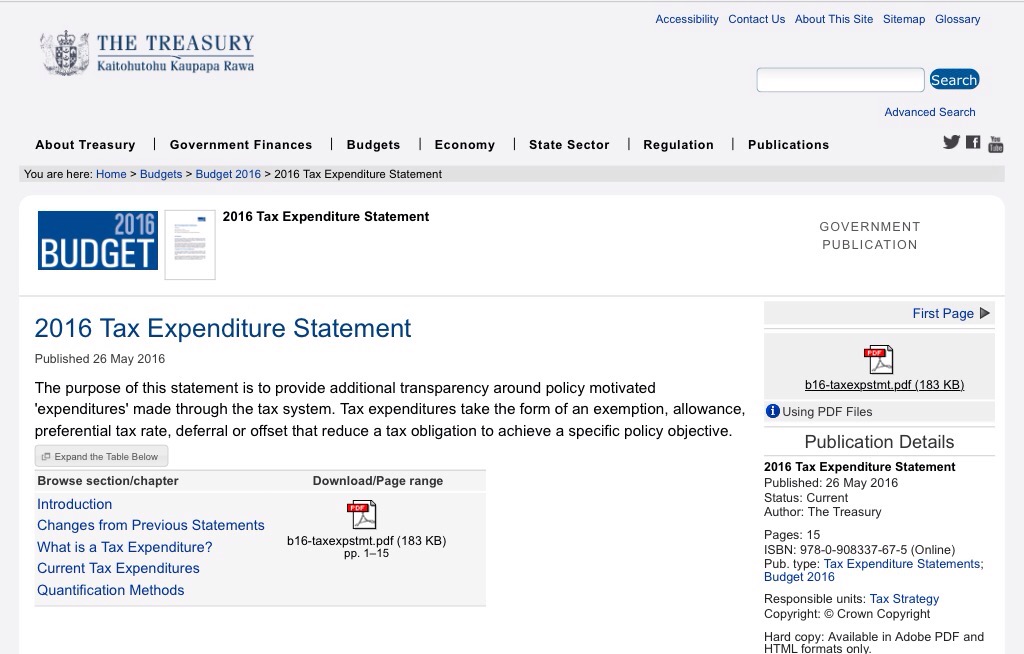
And so what are our sneaky expenditures?
There are what you would expect – tax exemption for Charities, donor rebate for Charities and Working for Families tax credits paid out through the tax system.
But there are also things you wouldn’t expect – and TES 2015 was quite notorious – exempting accommodation allowances to defence force personnel, ministers of religion, and Canterbury rebuild workers. Longstanding expenditures include the income equalisation scheme for farmers and accelerated depreciation for bloodstock. And do not get me started on the upfront deductibility of all forestry expenditure – including capital expenditure.
I am sure in other countries it is much worse but it is far from clear to your correspondent what makes these government expenditures so special that they should bypass Parliament every year.
But at least dear readers they are called out every year. And I would encourage you to look at them every year and ask questions. Because Parliament can’t.
Namaste
 Let's Talk About Tax NZ